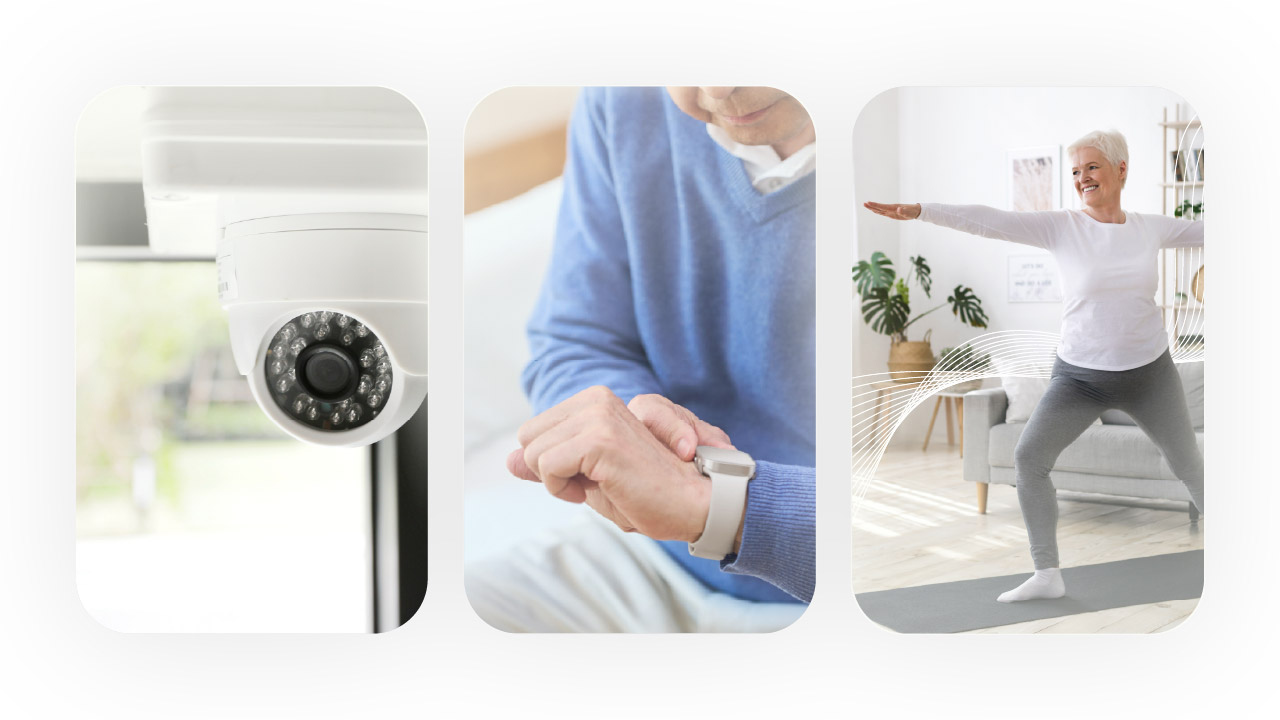
Cameras, wearables, and Ambient Care differ in both what they capture and what they require from the senior.
Cameras show what is happening but often face privacy objections and usually cover only the rooms in which they are installed. Wearables respond to specific events, typically a button press or a detected fall, but work only when worn and charged. Ambient Care follows activity patterns throughout the home without a lens or anything to wear, making it the most privacy-friendly senior monitoring option for continuous, everyday awareness.
What Cameras, Wearables, and Ambient Care Each Do
Cameras capture live or recorded images of a particular space. They can give family visual confirmation of what is happening, but they are also the option seniors are most likely to resist, particularly in bedrooms and bathrooms, where some of the most important changes may occur.
Wearables include pendants, watches, and clip-on devices designed primarily to respond to events. They can summon help after the senior presses a button, and some models can detect falls automatically. This makes them genuinely useful emergencies, whether or not the senior is able to call for help.
Ambient Care detects motion and activity patterns within the home without cameras, microphones, or devices worn on the body. It learns what a normal day looks like for an individual and surfaces meaningful changes over time.
A more detailed explanation is available in Reading the Room Without Watching It: How Passive Sensing Detects Change.[CS1]
The three approaches are not interchangeable. Each answers a different question about the same person.
Cameras vs. Wearables vs. Ambient Care: How They Compare
Cameras
What it captures: Images of what is happening
Coverage: Rooms in which cameras are installed
What the senior must do: Accept a lens in the room
Privacy profile: Lowest acceptance, particularly in bedrooms and bathrooms
Best suited to: Visual confirmation for family members
Wearables
What it captures: Events such as button presses and, in some cases, detected falls
Coverage: Wherever the device goes, while it is worn and charged
What the senior must do: Wear the device and keep it charged
Privacy profile: Worn on the body but does not capture images
Best suited to: Summoning help during an emergency
Ambient Care
What it captures: Motion and activity patterns over time
Coverage: The whole home
What the senior must do: Nothing
Privacy profile: No images or audio; does not identify who is moving
Best suited to: Continuous awareness of daily patterns and changes
The privacy gap is not simply a marketing claim. In a scoping review of research on older adults’ privacy perceptions of passive in-home monitoring technologies, cameras and visual data raised privacy concerns in 44 percent of the studies reviewed, while activity sensors were consistently viewed as more acceptable.
That matters operationally, because a system the senior rejects may be unplugged, left in a drawer, or limited to a hallway, reducing its ability to provide meaningful coverage.
How to Choose a Privacy Friendly Senior Monitoring System
Three questions can clarify which approach is most appropriate.
Which rooms need to be covered?
Changes in condition may first become visible through activities that take place in bedrooms and bathrooms: restless nights, slower mornings, more frequent overnight trips, or changes in hygiene routines.
When the rooms containing the most useful information are also the rooms where cameras are unwelcome, camera-based monitoring may miss an important part of the story.
What will the senior realistically do every day?
A wearable only works when it is being worn. The people who most need additional awareness may also be the people most likely to leave a pendant on the nightstand, forget to charge it, or remove it because it is uncomfortable.
Any system that depends on daily participation should be assessed according to realistic behaviour, not best-case assumptions.
Do you need to detect events, patterns, or both?
Emergency response and everyday awareness are different functions.
A wearable may help during the emergency itself. Ambient Care can provide information about the days or weeks surrounding that event, including changes that may have developed gradually.
Where Caregiver Fits Among the Options
Caregiver by Cognitive belongs to the Ambient Care category.
It uses whole-home Spatial Intelligence to detect motion and activity patterns across the living space through Wi-Fi signals already moving throughout the home. It requires no cameras, microphones, or devices for the senior to wear or charge.
A fuller explanation of the technology is available in What Is Spatial Intelligence in Home Care?[CS2] .
For home care agencies, this means the care team can understand a client’s usual daily patterns and receive an earlier indication when those patterns begin to change. Families gain greater awareness without placing their parent under a lens or requiring them to manage another device.
Caregiver is not a medical alert system and does not replace one. Instead, it addresses a question the other categories often leave unanswered:
What is normal for this person, and what is beginning to change?
Frequently Asked Questions
What is the most privacy friendly way to monitor a senior at home?
Ambient or passive sensing is generally the most privacy-friendly approach because it does not use cameras or microphones. It captures activity patterns rather than images and does not identify who is moving. Seniors accept it more readily than cameras because nothing in the home watches or records them.
Why do many seniors refuse cameras in their homes?
Cameras change how a home feels, particularly when they are installed in private spaces such as bedrooms or bathrooms.
Research into older adults’ privacy perceptions has consistently found greater concern about cameras and visual information than about less intrusive forms of in-home sensing. Refusing a camera is usually a decision about privacy and dignity, rather than an objection to technology itself.
What about seniors who will not wear a device?
Failure to wear or charge a device is one of the most common limitations of wearable monitoring.
Ambient Care requires nothing on the body, so it can continue to provide everyday awareness even when a client forgets a pendant, removes it, or refuses to wear one.
For emergency response, however, a wearable may still play an important role, particularly when the senior can press a button to call for immediate assistance.
Can Ambient Care detect falls?
Ambient Care is designed to identify activity patterns and meaningful changes over time. It should not be presented as a replacement for a dedicated fall-detection or medical alert device unless a specific fall-detection capability has been clinically and technically validated for that purpose.
For households that need both emergency response and ongoing awareness, Ambient Care can be paired with a wearable or medical alert system.
Can cameras, wearables, and Ambient Care be used together?
Yes. The most appropriate combination depends on the senior’s needs, preferences, and living environment.
A wearable may support emergency response, while Ambient Care provides continuous awareness of changes in daily routines. Cameras may also be useful in specific, agreed-upon locations when visual confirmation is necessary, and the senior is comfortable with them.
The goal is not to choose the technology with the most features. It is to choose a system the senior will accept and that provides the right type of information for the people supporting their care.